Showing posts with label Elder Care. Show all posts

Monday, June 15, 2009

Single payer health care is the only way to control costs

by Dr. Peter Mahr
Our current healthcare system is a mess for both those who carry health insurance and those without. Only a single payer national health insurance program that provides public financing for privately delivered healthcare services can clean up this mess and provide all Americans access to needed medical services regardless of ability to pay.

In a study released last week we learned that healthcare debt contributed to 62% of personal bankruptcies in 2007. And, surprisingly, 77% of those going bankrupt were insured when they first fell ill. The same year 47% of Americans reported some medical debt or payment problem and 16% of Americans had been contacted by medical debt collection agencies. Despite spending 16% of GDP on healthcare and increases in insurance premiums that dwarf growth in family income, millions are left bankrupt and 50 million more are uninsured. These figures highlight, in the starkest terms, how broken our employer-based private for-profit health insurance system is.

For all our money spent, the result is a fragmented complex healthcare system with poor outcomes. We are far behind other industrialized nations in terms of public health measures. Regional healthcare spending varies dramatically and has more to do with how many doctors there are per capita than other factors. The United States performs poorly on benchmark measures of preventative care and our management of chronic illness mirrors our chaotic and disorganized payment system. We consistently fail to meet evidence-based guidelines for chronic illnesses like diabetes and chronic lung disease.

At the same time business is booming for those who profit from healthcare. From 2003- 2007, the profits of the nation’s largest insurers rose 170.2 % to $12.6 billion. Pharmaceutical companies continue to gross billions of dollars with the top ten firms profiting a total of $75 billion in 2008. For-profit hospital chains and dialysis centers make millions while delivering worse outcomes when compared to non profit alternatives. Surgical sub-specialists make 3-4 times what generalists make.

So what do we do with a healthcare non-system that is a big money maker for insurers, some hospitals and the pharmaceutical industry but leaves one in seven people lacking insurance and most with insurance that is too costly and inadequate? How do we repair a delivery system that is expensive, focuses on moneymaking services rather than primary and preventative care and has little emphasis on evidence-based medicine?

Clearly the solution is to adopt a single payer national insurance program: publicly funded and privately delivered. We already pay for our current system with out of pocket payments and taxes.

Personal income taxes pay for Medicare, Medicaid, public employee health insurance, tax breaks to employers who provide health insurance to their employees and healthcare coverage for military personnel and veterans. The sum total comes to 60% of our total health insurance costs. In essence, we are paying for national health insurance now. We just aren’t getting it. Instead, a single payer system would use tax dollars to provide true comprehensive healthcare coverage for all.

Furthermore, a single payer system is the only reform proposal that would drastically reduce the staggering administrative costs that accompany our private insurance industry. Profit margins, overhead and administrative costs associated with our current private insurance industry remove $350 billion from the healthcare system each year. In reducing administrative costs a single payer plan would save enough money to cover the 50 million uninsured.

Single payer health insurance also holds great promise for reforming the delivery of healthcare. With single payer, a reimbursement system can realign the delivery of healthcare services from one of maximizing profit to one in which we maximize health. Reimbursement for primary and preventative care can be emphasized while specialist and end of life care can be more rationally utilized. Regional spending can be leveled. And a one payer system can bargain effectively with the pharmaceutical
industry, driving down medication costs which currently add $98 billion a year to the cost of our healthcare system.

In short, only a single payer system that eliminates for-profit, private health insurance can generate the cost savings to pay for a truly universal healthcare system. And, only a single payer system, with the tools of bulk purchasing, negotiated fees and global purchasing, can realign our delivery system to emphasize primary preventative care while bringing sanity to our skyrocketing healthcare s pending. A majority of the public and a majority of physicians support the adoption of single payer health insurance.

Now is our chance to embrace true reform.

Dr. Mahr is a family physician who works for the Multnomah County Health Department at East County Health Center in Gresham, OR. He is also chairman of the Portland Oregon chapter of Physicians for a National Health Program.


Read more!

Wednesday, February 25, 2009

Ezra Klein: How Entitlement Reform Became Health Reform

Medicaid and Medicare pay for health services on the private market; keeping those program costs under control depends on broad health reform. Check out the graphs at the "read more" link.

Published online at the American Prospect, February 23, 2009

It's testament to how deeply the idea of an entitlement crisis has embedded itself in Washington that news that Obama planned a "fiscal accountability summit" was immediately taken as proof by The Washington Post that he was readying a frontal assault on Medicare, Medicaid, and Social Security.

It was an understandable leap for the paper to make. Fiscal responsibility has, in this town, long been an anodyne synonym for entitlement reform. The "responsible" part signaled that you were courageous enough to cut treasured social programs in service of the national debt. The left, which never bought into this ruthlessly austere vision of responsibility, reacted with a defensive fury. It had just spent eight years protecting the entitlement programs from sharp-knifed "reformers." Would it have to do so again?

Today's "White House Fiscal Summit" will take place at 1:30 in the State Dining Room. It will feature speeches from the president and vice president and "breakout" sessions where Cabinet officials and White House advisers will gather in small groups to work on health care, Social Security, taxes, contracting and procurement, and the budget. (You'd think, by the time you were appointed to a presidential Cabinet, you'd be rid of "breakout sessions." You'd be wrong.) Notice what's not in there: Entitlement Reform.

Its absence is the product of a quiet but powerful change in thinking that has taken place in the offices of elite Washington and, now, the halls of the White House. Where a decade ago the looming fiscal threat of entitlement spending led economists and budget wonks to wear out their worry beads, today a more subtle understanding of our fiscal future dominates. In this telling, there's no such program as "SocialSecurityandMedicareandMedicaid." There's Social Security, which has modest long-term liabilities and needs little, if any, help. And then there's health-care reform. "That," says Henry Aaron, a senior economist at the Brookings Institution, "is the big kahuna."

How this happened depends on whom you talk to. Dean Baker, an economist at the Center for Economic and Policy Research, points to the 2005 Social Security privatization fight. "A lot of people were suddenly out there arguing that there's no crisis and we don't need to do anything on Social Security," he says. That forced left-of-center wonks who'd not thought much about the crisis to confront the numbers or, more precisely, the graphs. "We've done a graphic that shows what deficits look like in every country with longer life expectancies than us and what the deficit looks like going 70 years with the same per-capita health-care costs of that country."


It's a startling image. That orange line shooting into orbit? That's our projected deficit. That blue line levitating gently upward? That's our deficit if health costs grew more slowly. And those other lines sinking downward? They're our deficit if we had the per-person health costs of countries like France, Germany, and Canada. In all cases, Social Security spending remains unchanged.

Aaron locates his light-bulb moment in a paper written by Richard Kogan, Matt Fiedler, Aviva Aron-Dine, and Jim Horney for the Center on Budget and Policy Priorities. He remembers sitting around a table with Peter Orszag, now director of Obama's Office of Management and Budget, Bob Reischauer, who runs the Urban Institute, Bob Greenstein, who founded the CBPP, and an array of other economic luminaries while Kogan and Horney presented their findings. "The long-term fiscal outlook is bleak," they wrote, and "rising health care costs are the single largest cause."

Aaron says that the "meeting was sort of a slap-the-forehead moment. I said 'you guys are saying there is no problem other than a health-care financing problem long-term!' Credit goes to them, in my opinion." (An updated version of their paper, written with Kris Cox, can be downloaded here.)

What everyone agrees on is that the thinking entered government in the person of Peter Orszag. In 2007, Orszag was named director of the Congressional Budget Office. From that perch, he brought Kogan and Horney's thinking to the halls of Congress. Orszag liked to show a particular slide in his public presentations and speeches that broke down the interplay between the government's various fiscal commitments:


Government spending and Social Security, it says, will hold relatively constant in coming years. It's Medicare and Medicaid that chew up federal spending.

This graph, however, could be used as evidence for a simple focus on Medicare and Medicaid. The programs are unsustainable. They need to be slashed. The next slide in Orszag's presentation is titled "misdiagnosing the problem." The fiscal threat, it argues, is not more beneficiaries or the type of beneficiaries that are the factors internal to Medicare and Medicaid. It's the cost per beneficiary. Orszag has a graph for this, too:


And since Medicaid and Medicare pay for health services on the private market, this can only be fixed through broader health reform. Orszag now directs the Office of Management and Budget. He will lead today's "health care" breakout session. Richard Kogan works for him. So it's no surprise that asked for details on today's fiscal summit, one senior administration official told me that "the most likely outcome at this point is that we focus on health care given that it's the key to our fiscal future." Another explained the focus starkly. "Health is mathematically bigger," he said. The rumors originally held that eager entitlement cutter Peter G. Peterson would give the day's keynote. Now Robert Greenstein, director of the very think tank that released Kogan and Horney and Cox's paper, will speak.

Fiscal responsibility, in other words, is no longer a stand-in for entitlement reform. In Obama's Washington, it means health reform.


Read more!

Paul Waldman: There Is No Social Security Crisis

The conservative call for Social Security privatization has been drowned out by that crashing noise from Wall Street, but fear-mongering over long-term solvency continues. Should we believe the hype?

Published online at the American Prospect, February 24, 2009

There's a time-tested way to curry favor with the permanent Washington establishment. That is, having David Broder praise you for being "responsible" and being considered a Very Serious Person by the Sunday shows. All you need to do is proclaim ominously that entitlements are a ticking time bomb, a looming storm on the horizon, a hungry beast ready to devour our nation's finances, or whatever metaphor you find most frightening. The more unpleasant the solution you propose -- tax increases are good, but benefit cuts are even better -- the more the Beltway Brahmins will approve.

So yesterday's White House entitlement's summit, which appeared, when announced, to repeat the conventional doomsday wisdom, wasn't too much of a surprise. And indeed, at various times over the past couple of years, President Obama has seemed to suggest that he will be addressing this thorny long-term problem, leading to no end of heartburn among progressives who view Social Security as one of the cornerstones of the American social contract.

But as he has made clear, Obama is not unsheathing his blade to begin hacking away at our government pensions. Nonetheless, because conservatives will continue to conflate issues that should be separate and to further the assault on Social Security launched at the program's enactment in 1935, it's an opportune time to get a few things straight. The most important is this: There is no Social Security crisis.

If there is an "entitlement crisis," it's a crisis in Medicare. But as Ezra Klein explains so well, there really isn't a Medicare crisis, either. Medicare's funding problem is a problem of the ballooning cost of health care in general; fix that, and you've fixed the Medicare problem.

The myth of the "Social Security crisis" is so pervasive and so pernicious that it's necessary for those of us who actually believe in the program to respond to the crisis-mongers whenever we can. And they've got muscle -- witness the recent round of full-page newspaper ads featuring a looming iceberg and screaming headlines about the $56 TRILLION!!! we're supposedly in the red (these are funded by hedge-fund billionaire Pete Peterson, the Daddy Warbucks of the entitlement fear factory). So let's examine what the crisis-mongers say, and what the truth is.

For years, we've been told that Social Security is "going broke." It is also often said that at some future point, the program will "run out of money." Just last week, The Washington Post said matter-of-factly that "Social Security is projected to run out of money by 2041." This implies that at some future date, elderly recipients of Social Security will receive checks in the amount of $0, all the money having disappeared.

This is simply bogus. The truth is that the system is quite healthy and can meet all its future obligations with only minor adjustments or perhaps no adjustments at all, depending on what happens to the economy over the coming decades.

Before we get to that, let's remember how Social Security works. The payroll tax on today's workers is used to pay out benefits to today's retirees. When you retire, your benefits will be paid by people working then. (Of course, to many conservatives, a system built on this kind of mutual obligation is redder than Joe Stalin's underwear.) For some time now, the taxes being paid in have exceeded the benefits being paid out. What's left over goes into that famous "Social Security trust fund," also known as the Social Security surplus. The trust fund is still growing; in 2007, $179.3 billion was added to the fund, bringing its total to over $2 trillion.

If we weren't concerned about the future of the program, we could just take every bit of the collected Social Security taxes and pay them out in (extremely generous) benefits. That wouldn't be very smart, though, because that would leave us with nothing left over for the day when we start collecting less in taxes than we need to pay in benefits.

Enter the baby boomers, that endlessly self-absorbed, blood-sucking leech of a generation (I kid). Boomers have just begun to retire; in a few years, their numbers will cause the system to pay out more than it pays in. According to the Social Security trustees, who are responsible for overseeing the system, this will happen in 2017.

The prophets of doom believe that this date -- 2017, remember it, because they'll always bring it up -- is when the sky will tear loose from its moorings and begin hurtling toward our heads. But here's the thing: The period of benefits exceeding tax payments that is supposed to begin that year is exactly the reason why the Social Security surplus exists in the first place. We keep adding to the surplus every year precisely so that it will be there to draw on when we need it. And the baby boomers' retirement is when we'll need it.

But ah, you say, what happens when the trust fund is exhausted? Isn't that when all hell breaks loose, as the system truly "goes broke"?

No. The system will never "go broke." If you listen to the most commonly used estimate (we'll get to its inherent problems in a moment), the trust fund will run out in 2041, 32 years from now. "Even if a trust fund's assets are exhausted, however," the trustees write, "tax income will continue to flow into the fund. Present tax rates are projected to be sufficient to pay 78 percent of scheduled benefits after trust fund exhaustion in 2041 and 75 percent of scheduled benefits in 2082."

Like anyone else, I'd much prefer getting 100 percent of my benefits, rather than 75 percent of my benefits. But a "broke" system would give you zero percent, so if 75 percent is what the system can pay, I'll take it. A system that pays 75 percent of benefits isn't great, but it's not a disaster either.

Now we get to the reason why the system may actually be able to pay all its benefits. If you're going to make a prediction about tax revenues coming in over the next 75 years, as the Social Security Trustees must, you're going to have to make some assumptions about the economy. The stronger the economy is, the more people will be employed and the more they'll be earning, so the more tax revenue we'll have. The weaker the economy is, the less revenue we'll have. So what do the trustees assume about the strength of the economy? It turns out that their assumptions are remarkably pessimistic.

The trustees actually make three sets of predictions: a "high cost" prediction (the pessimistic one), a "low cost" prediction, and an "intermediate" prediction. The intermediate prediction is the one that gives us the 2041 date for the exhaustion of the trust fund. But it isn't just the "high cost" prediction that is pessimistic -- all three are.

As bad as things are right now, it's important to remember that the economy is going to recover from our current crisis. And after it does, we'll experience up periods and down periods, just as we have before. Although nobody can say what the economy is going to be like 30 or 40 years from now, the best tool we have to predict long-term economic growth is past performance.

But for some reason, the trustees are of the opinion that in the upcoming decades, the economy is going to grow at a far slower rate than it has. Although gross domestic product growth averaged 3.1 percent from 1966 to 2006, all three of the trustees' projections assume GDP growth lower than that. Even the optimistic "low cost" projection assumes that GDP will average 3.1 percent only until 2017, after which it predicts that growth will slow, averaging 2.9 percent for the rest of the 75-year window they're projecting. The "intermediate" projection assumes that economic growth will average 2.1 percent after 2017.

That's a prediction of pretty anemic growth, but that's the "intermediate" projection which everyone uses when talking about the future of Social Security. And perhaps it will prove true. But it seems that it wouldn't be too radical to assume that the "low cost" projection -- the one in which the economy over the next 75 years looks a lot like it has in recent decades -- is the one that will be closer to reality.

And what happens if you accept that low-cost projection? When does the Social Security trust fund run out in that case? Never. It never runs out (here's the graph, if you're interested).

The Social Security trustees aren't the only ones who have tried to crunch these numbers; the Congressional Budget Office estimates that the trust fund will be exhausted in 2049, not 2041, and that at that point tax revenues will cover 84 percent of benefits, not 78 percent. But looking at all the various projections, one has to conclude the following:

At some point, somewhere between 30 and 70 years in the future, the Social Security trust fund may be exhausted. If it is exhausted and taxes are not raised, beneficiaries will see a reduction in benefits that will be meaningful, though not catastrophic.

If that's how you understand the issue, it suggests that a fix to ensure that benefits end up where they're supposed to needn't be anything radical. You could raise the cap on Social Security taxes, for instance (the tax is only paid on the first $106,800 of income, meaning most people pay it on 100 percent of their salaries, while Alex Rodriguez pays it on less than 4 percent of his salary). If, on the other hand, you think the system is in crisis and is going broke, you're going to favor much more painful solutions.

Thankfully, President Obama seems to understand the difference between a manageable problem and a looming calamity. "Social Security, we can solve," he recently told The Washington Post with a dismissive wave of his hand. But we know that the conservatives will continue to harp on the myth of the Social Security crisis. One positive result of the economic meltdown is that they've been deprived of the main weapon they had in their arsenal on this issue: an alternative proposal. Until last year they had an analysis of the problem (the program is going broke) and a solution (privatize it). They could claim, however disingenuously, that they were offering a painless alternative: Put Social Security funds in the stock market, and everyone will get rich.

No one's going to say that now, of course, and probably not for a long time to come. Former President Bush's 2005 attempt to partially privatize Social Security was a spectacular flameout, and that was when the stock market was riding high. So all the Social Security Chicken Littles have to offer now is tax increases (unpopular) and benefit cuts (really unpopular).

The real problem is not that their solution to the crisis is unpalatable. It's that there is no crisis. Don't let them tell you otherwise.


Read more!

Monday, February 2, 2009

Cognitive Dissonance: The Healthcare Reform Battle's State of Mind

by Donna Smith. Published on Friday, January 30, 2009 by CommonDreams.org

It seems everyone in the healthcare reform movement is hitching up his or her britches and feeling mighty proud of the prospects for action under President Obama and the adoring Democrats in his Congressional arsenal. Even some prominent Republicans are inching ever closer to supporting change to the broken health system. But I'm feeling significant dissonance between the words spoken and the policy offered to move forward.

So listening to the speakers here at the Families USA Health Action meeting this week has been upsetting - OK, it is outrageous to watch these folks being self-congratulatory while also promoting those purporting the overhaul of the health system with the biggest bailout we've yet given any industry in recent months. The proposed mandates for all Americans to purchase private, for-profit health-insurance (or buy into a public pool that will be weakened by the insurance interests) is being sold to us as reform and it simply is not. And my brain hurts from the disconnect.

I cannot reconcile Princeton's Uwe Reinhardt's message that we've become an aristocracy - not a middle-class society or even a democracy - with his embrace of the insurance industry and expansion of the broken healthcare system that clearly provides better healthcare protection for our American royalty and not the peasants among us. He carefully charts for us the rising debt of American families - including crushing medical debt assumed under the for-profit health insurance based system-and the lack of savings by Americans in recent years. But there is little acknowledgment that some of the debt and lack of savings directly relates to the increased costs American families and workers must shoulder for health coverage - health coverage that doesn't adequately protect financial standing.

Sen . Charles Grassley of Iowa assured the crowd that there's a big difference between the Hillary Clinton plans of years gone by and the Obama plan now - "He (Obama) will stick to his guns on a private-public mix (for insurance)." Grassley goes on to say everyone knows you get over-utilization when you have "gold-plated" plans. The implication is always that if you give access to care then millions of us will clamor to sit in doctors' offices and get procedures and tests done simply because we have the means to do so. I actually think the gold-plated stuff will be reserved for Sen. Grassley and his cohorts - the rest of us will work hard to even get a plan that can assure minimal coverage or care. Grassley said they'd remind the Democrats that they said they'd adhere to a "pay as you go" with healthcare reform and other programs. Here's the nod to the "bi-partisan" efforts we hear will guide the day for us all - the new agenda, the cooperation that will bring us all to the promised land of expansion of the insurance industry.

Then the Dems. I hear Rep. Steny Hoyer rightfully cite his outrage about a Maryland child dying for want of a tooth extraction, yet stay safely and clearly away from angering the insurance industry. I listen as Sen. Debbie Stabenow of Michigan talk about her compassion for families struggling for care yet quickly adding when she talks about providing healthcare for immigrants that we should reward with healthcare those doing "the right thing." I have a hard time reconciling the disconnect between the suffering unfolding every day - death by death by denial by denial - as the dance continues.

We want a "uniquely American" answer to the healthcare nightmare, they all say. I've heard that until my brain hurts just considering it. Oh, we're unique all right. We're the only industrialized nation on earth that tolerates the killing of its citizens on our own soil at the hands of this healthcare system and then wants to fix it all by handing more business, more money and more power to the same industry committing the murders. That's unique enough.

None of this sounds like the language of basic human rights. And I think I heard our new President say that he clearly understood healthcare to be a human right in response to a debate question just a few months ago. That was such a gift just to hear the words spoken. I just know he knows that this basic human right is not going to be protected by hoodwinking the American people into bailing out the insurance industry.

The heavily funded activists (come on folks, that alone should send up big, red flags - heavily funded activists for human rights?) pushing for a private-public national healthcare policy are in and of themselves a conundrum to me. I hear on the one hand the message that the private, for-profit health insurance industry is very bad indeed - blocking healthcare through denials and high premiums and all the practices the American people have had to endure for years. But then I also see the activists and the industry folks co-mingling ever so deftly in a dance of political theater aimed at convincing us all that in response to demands for insurance regulation and restriction the industry will put up a fight but then capitulate to the demands or risk being left behind.

Look at the list of bedfellows and trust your instincts America. Like our moms and dads taught us, if it walks like a duck and quacks like a duck, guess what? It's a duck. A bailout called healthcare reform is still a bailout even if we're told otherwise. If AARP and UnitedHealth Care and Wal-Mart and SEIU and the others in the HCAN coalition are joining hands and forces, is there anyone among us who doesn't know that's about money and power and influence still? That's a duck. And that's going to be a very well treated duck.

So, let me get this straight... the insurance industry has been a big part of the problem. Worse. The industry has allowed the deaths of tens of thousands of Americans every year in order to protect profits.

I think of dead -- 2-year-old Mychelle Keyes and dead 17-year-old Nataline Sarkisyan and dead 38-year-old Tracy Pierce, and that dead little boy with an infected tooth in Maryland -- and I don't wonder at all what the new for-profit insurance-friendly political coalitions are fighting to protect. And it isn't the future Mychelle's or Nataline's or Tracy's. They are fighting to protect the folks who killed them.

All of these dead were killed at the hands of the industry now being simultaneously chastised and coveted. This same greedy industry can be trusted to roll over just a little while helping craft their own industry's regulations going forward? Oh, yes, that seat at the table is firmly fixed and being kept ever so warm for the insurance folks. In exchange for setting some of their own regulation, the insurance industry will be rewarded with the business of millions more of us who have had absolutely no say in the matter. None.

Those Americans not acting as political operatives for the quasi-activists organizing the reform transition for the insurance industry are not exactly anxious to hear from you and me. No, they have well-heeled and well-connected leaders who rub elbows and move easily within all of the halls of power where we can never go.

And unless we rise up and say we know what is going on and we smell a lot of big, fat rats, reform that expands the broken system and enriches the already elite of the healthcare profit-mongers will be sold to us by bipartisan bluffing and insurance company operatives slip-sliding us forward.

As for me, I will keep listening to Rep. John Conyers talk about human rights and healthcare for all and the long arc of history leaning towards justice. Oh, and his talk about how the automakers just barely across the river in Canada can build cars much more cheaply than in his native Michigan because they don't suffer the health-insurance nightmare. Huh? Human rights and good business. I do like the quack of that. And my dissonance subsides...

Donna Smith is a community organizer for the California Nurses Association and National Co-Chair for the Progressive Democrats of America Healthcare Not Warfare campaign.


Read more!

Wednesday, July 16, 2008

Paul Krugman: A little closer to universal coverage

This good news in Paul Krugman's report on the initial Senate vote has stayed good--yesterday both House and Senate overrode Bush's veto on Tuesday by wide margins. This column originally appeared in the July 11th New York Times

It was the worst of days, it was the best of days. On Wednesday, Senate Democrats capitulated to the Bush administration on wiretapping — with Barack Obama joining the coalition of the craven.

Later that day, however, those same Senate Democrats won a huge victory on Medicare.

News reports stressed the cinematic quality of the event: Ted Kennedy, who is fighting a brain tumor, made a dramatic appearance on the Senate floor, casting the decisive vote amid cheers from his colleagues. (Only one senator was absent: John McCain.)

But the vote was bigger than the theatrics. It was the first major health care victory that Democrats have won in a long time. And it was enormously encouraging for advocates of universal health care.

Ostensibly, Wednesday’s vote was about restoring cuts in Medicare payments to doctors. What it was really about, however, was the fight against creeping privatization. Democrats finally took a stand — and, thanks to Senator Kennedy, seem to have prevailed.

The story really begins in 2003, when the Bush administration rammed the Medicare Modernization Act through Congress, literally in the dead of night. That bill established large de facto subsidies for Medicare Advantage plans — plans in which Medicare funds are funneled through private insurance companies, rather than directly paying for care.

Since then, enrollment in these plans has been growing rapidly. This has had a destructive effect on Medicare’s finances: the fastest-growing type of Medicare Advantage plan, private fee-for-service, costs taxpayers 17 percent more per beneficiary than Medicare without the middleman. It also threatens to undermine Medicare’s universality, turning it into a system in which insurance companies cherry-pick healthier and more affluent older Americans, leaving the sicker and poorer behind.

What does this have to do with cuts in doctors’ fees? Well, legislation passed a decade ago makes such cuts automatic whenever the growth in Medicare spending exceeds an unrealistically low target. This year, the automatic cuts would have reduced doctors’ payments by more than 10 percent, a pay reduction so deep that many physicians would probably have stopped taking Medicare patients.

In previous years, payments to doctors were maintained through bipartisan fudging: politicians from both parties got together to waive the rules. In effect, Congress kept Medicare functioning by expanding the federal budget deficit.

This year, the Democratic leadership decided, instead, to link the “doctor fix” to the fight against privatization and offered a bill that maintains doctors’ payments while reining in those expensive private fee-for-service plans. Last month, the Senate took up this bill — but Democrats failed by one vote to override a Republican filibuster. And that seemed to be that: soon after that vote, Senators Max Baucus and Charles Grassley had another bipartisan fudge all ready to go.

But then Democratic leaders decided to play brinkmanship. They let the doctors’ cuts stand for the Fourth of July holiday, daring Republicans to threaten the basic medical care of millions of Americans rather than give up subsidies to insurance companies. Over the recess period, there was an intense lobbying war between insurance companies and doctors.

And when the Senate came back in session, it turned out that the doctors — and the Democrats — had won: Senator Kennedy was there to cast the extra vote needed to break the filibuster, a number of Republicans switched sides and the bill passed with a veto-proof majority.

If the Democrats can win victories like this now, they should be able to put a definitive end to the privatization of Medicare next year, when they’re virtually certain to have a larger Congressional majority and will probably hold the White House.

More than that, however, advocates of universal health care, like Health Care for America Now, the new group headlined by Elizabeth Edwards, have to be very encouraged by this week’s events.

Here’s how it will play out, if all goes well: early next year, President Obama will send his health care plan to Congress. The plan will face vociferous opposition from the insurance industry — but the Medicare vote suggests that this time, unlike in 1993, Democrats will hold together.

Unless Democrats win even bigger than expected, however, they won’t have the 60 Senate votes needed to override a filibuster. What the Medicare fight shows is that the Democrats could nonetheless prevail by taking their case to the public, daring their opponents to stand in the way of health care security — so that in the end they get some Republicans to switch sides, and get the legislation through.

A lot can still go wrong with this vision. But the odds of achieving universal health care, soon, look a lot higher than they did just a couple of weeks ago.


Read more!

Monday, January 21, 2008

Selling Out Grandma

By Emily Udell
January 21, 2008
http://www.inthesetimes.com/article/3486/selling_out_grandma/
http://www.truthout.org/docs_2006/012108H.shtml


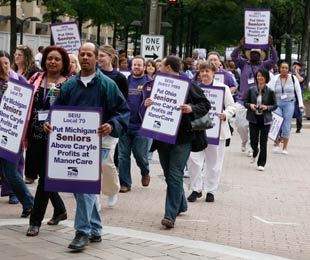
Protestors picket outside the Carlyle Group's headquarters in Washington, D.C., in September 2007

In late 2007, the investment firm The Carlyle Group purchased one of the country’s largest nursing home chains despite the concerns of regulators, lawmakers and workers’ groups that the acquisition would lead to staffing cuts and cause a decline in quality of care for residents. The $6.3 billion purchase of Toledo, Ohio-based Manor Care Inc. closed after a Michigan judge lifted a restraining order that temporarily halted the sale.

“The problem is, in the nursing home industry, making money means cutting care,” says Julie Eisenhardt, a spokeswoman for Service Employees International Union (SEIU), which represents employees at about 15 Manor Care homes and which spearheaded a campaign to raise awareness about the buyout.

In 2006, Manor Care, which operates more than 500 nursing, rehabilitation and assisted living facilities in 32 states, posted $167 million in profits and $3.6 billion in revenues. Manor Care shareholders were slated to get $67 for each share as part of the deal.

The Carlyle Group has holdings in several industries, including healthcare, defense and energy. Former President George H.W. Bush was one of its advisers until 2003.

Officials from both firms have denied plans to reduce staffing or slash services following the takeover, and have said Manor Care will continue to be run as it was before the buyout. “There’s not going to be a cut in staff and there’s no reason for quality to go down,” says Rick Rump, a spokesman for Manor Care. “Carlyle is going to realize a return in investment by our company growing and becoming a better provider of healthcare.”

The deal’s critics also say investment companies create Byzantine ownership structures that impede regulation and shield the firms from accountability for negligent care or wrongful death accusations.

Rump says that Carlyle would not separate its assets from its operations as some private equity firms have done and that the Manor Care management team would remain the same.

Carlyle officials did not return calls by deadline, but Karen Bechtel, the company’s managing director and global head of healthcare, said in a statement: “We are pleased to back a high-quality company and management team. We support [Manor Care CEO] Paul Ormond’s strategic vision and support his commitment to quality patient care.”

But a preliminary study of a large nursing home chain owned by a private investment firm found that staffing of registered nursing homes dropped by 8 percent and deficiencies that harmed residents doubled.

“They’re not there to invest in the care for the residents, they’re there to make money,” says Charlene Harrington, a professor of nursing at the University of California, San Francisco, and author of the 18-month study. “The way these chains have made money is by cutting the staff to the bare bones and pocketing the profits.”

Harrington, who is part of a team that has researched nursing homes for 25 years, says the privatization of chains allows companies to shirk regulatory scrutiny because they are not required to file financial documents with the Securities and Exchange Commission (SEC) or state regulatory agencies.

“These chains have had so many quality problems that they have wanted to go private in order to keep from having the litigation they have,” she said.

A recent New York Times analysis of government data from 2000 to 2006 found that the quality of care declined at nursing homes that were taken over by investment firms such as Warburg Pincus and Carlyle because of cost-cutting and staff reduction.

David Adams, 40, entered one of Manor Care’s homes in Pittsburgh, Pa., after he ruptured his Achilles tendon playing basketball. He says the care at the Shadyside Nursing and Rehabilitation Center was substandard before the takeover, and he’s concerned it will only get worse.

“They’re coming up short—they do the minimum they can get away with and no more,” says Adams, a former construction worker and cook, who testified during state hearings in Pennsylvania on the buyout. Adams says he contracted infections because his bandages weren’t changed regularly, received the wrong medication and was stranded for 45 minutes after falling in his bathroom.

“One day I will leave,” he says, “but there are people that are going to die here.”

The Carlyle Group’s buyout was announced last summer and given the green light by the SEC. Shareholders approved the deal in a December 2007 meeting. After the sale, several state health departments, including those in Illinois and Michigan, still had to approve the transfer of licenses from Manor Care to Carlyle, but Manor Care’s Rump says he expected the transfers to be granted.

In November, legislators in Washington, D.C., held hearings on the issue of care at facilities owned by private investment firms, and hearings took place in several states.

In West Virginia, regulators reconsidered their initial approval of a deal just days before the completion of the sale. But after a Dec. 14 hearing, the state Health Care Authority lifted a stay on the approval, which would affect seven West Virginia nursing facilities. Manor Care had protested the stay, saying the delay was costing investors $1 million per day.

In Illinois, legislators and union leaders voiced concern about the deal.

“I think the size of the transaction, the nature of the business of the proposed buyer and the effects that could be felt by our most frail and vulnerable populations require us to give the proposal extra scrutiny,” said State Rep. Greg Harris (D-Chicago) at a December hearing before the Illinois Department of Public Health, which regulates the state’s nursing facilities.

In December, financial news service Bloomberg reported that the Manor Care purchase was the eighteenth sale of a nursing home operator in the United States in four years. Experts say investment firms’ interest in nursing facilities is partially an effort to cash in on the aging of baby boomers into the system.

“As boomers get older, taking care of them is going to be big business,” says Eisenhardt of SEIU. “The question is: Do we as a society think it’s right that people are trying to make money off taking care of our most vulnerable population?”

Emily Udell is an itinerant journalist who has reported for the Daily Southtown newspaper in southwest Chicago, the Associated Press in Indianapolis and Radio Prague in the Czech Republic. She was co-host of In These Times' monthly radio show "Fire on the Prairie."

More information about Emily Udell


Read more!